
How Braille Works
Braille is a method of reading by touch
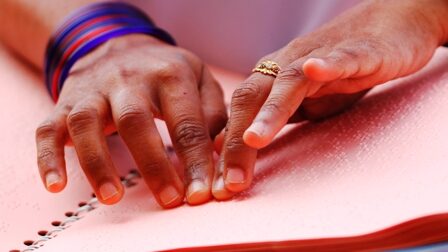
Louis Braille
Braille was invented in 1825 by Frenchman, Louis Braille, who was born in Coupvray, France in 1809.
Louis had an accident in his father’s workshop when he was only 3 and soon after he went blind. His parents found ways in which to teach Louis to read and write and when he was 7 they sent him to school.
Louis felt that the methods used in teaching visually impaired people were unnecessarily difficult, so at the age of 13 he set about devising a new system using raised dots – at 15 he had completed the alphabet.
By 1829 he had added music to his system and he wrote a booklet explaining how to read words and music by touch but it took many years before Louis’ raised dot system was officially adopted. Learn more about Louis and his Braille system.
The Braille Cell
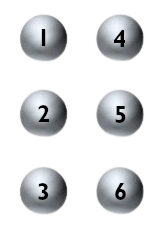
Braille is made up of cells measuring approximately 0.5 cm wide and 1 cm high, just the right size to be read by the fingertip.
In standard “6 dot braille” each cell may contain up to 6 raised dots. By convention the dots are given numbers 1-6.
There are 64 possible patterns of raised dots. These make up the braille characters which are used for the braille system.
The Braille Alphabet
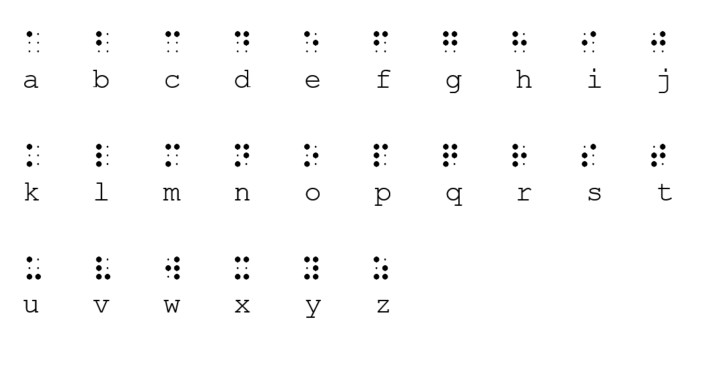
In the diagrams below raised dots are shown by the larger black circles whilst potential raised dot positions are shown by small dots.
The following diagram shows the lowercase letters of the English alphabet, each with its corresponding braille symbol above it.
Capital letters
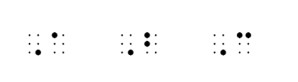
Capital letters are indicated using the capital sign (dot 6 in English braille) before the letter. Here are capital letters A B C:
Numbers
Numbers are formed by using a numeral sign ⠼ (dots 3,4,5 and 6) followed by the braille symbols for letters a-j which, when preceded by the numeral sign, represent 1-9 and 0. Below are the numbers 1-10:

Contractions
For speed and to save space English braille and some other languages use “contractions” that substitute shorter sequences for the full spelling of commonly-occurring letter groups. For example, “the” is usually just one character in English braille, not only in the definite article but also in words such as “further”. However, the same contraction is not used in words such as “sweetheart” because of the way in which certain words are constructed or pronounced.
When contractions are used, the braille is usually called “contracted braille” or “grade 2” in contrast to “uncontracted braille” or “grade 1” braille where every word is spelled out letter-by-letter.
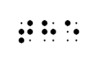
“the” in uncontracted (grade 1) braille

“the” in contracted (grade 2) braille
Most of the languages we produce use grade 1 braille and, because braille is not an international language, each language has its own official braille code.
Different Languages and Scripts
The same 6 dot system can be used to code for the letters of most of the world’s written languages.
English
Jesus → ⠠⠚⠑⠎⠥⠎
Hindi
यीशु → ⠽⠔⠩⠥
Urdu
یِسُوع → ⠊⠑⠎⠥⠺⠷